
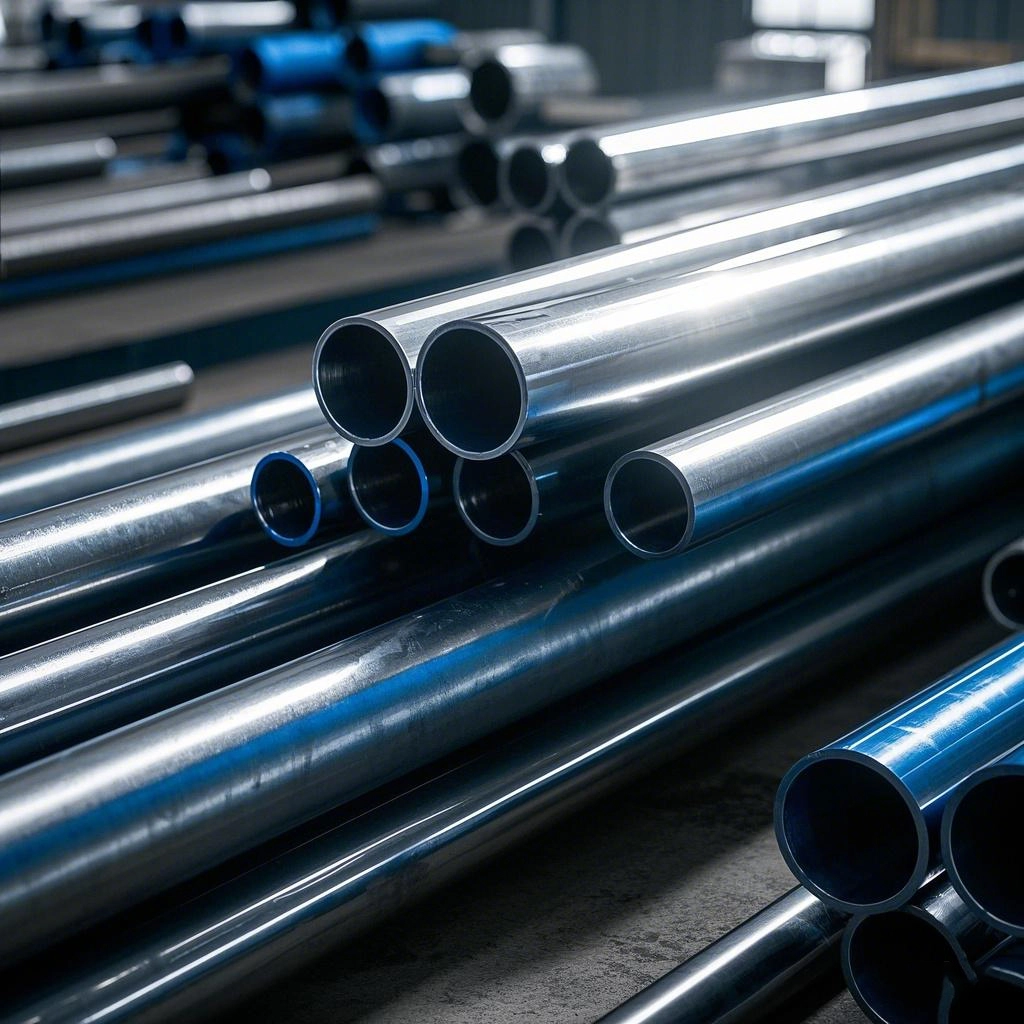
Alloy 690 possesses outstanding resistance to intergranular corrosion and intergranular stress‑corrosion cracking, and is mainly utilized for heat transfer tubes of steam generators in pressurized‑water‑reactor nuclear power plants.
Materials for steam generator heat transfer tubes of pressurized‑water reactors have undergone successive development, covering 304 austenitic stainless steel, Alloy 600, Alloy 800 and Alloy 690.
Researches on in‑service corrosion failures of Alloy 600 reveal that intergranular corrosion and intergranular stress‑corrosion cracking are its dominant failure causes.
Put into service since the 1990s, Alloy 690 used as steam generator heat‑transfer tube material for pressurized‑water‑reactor plants has not had any reported damage incidents.
Inconel 690 Bars UNS N06690/NiCr30Fe/NS3105
| Chemical Composition | Carbon (C): ≦0.050% | Chromium (Cr): 27%~37% |
| Nickel (Ni): Balance | Iron (Fe): 7%~11% | |
| Manganese (Mn): ≦0.50% | Silicon (Si): ≦0.50% | |
| Ni: 41-42.5% | Sulfur (S): ≦0.015% | |
| Copper (Cu): ≦0.5% | ||
| Physical Properties | Density: 8.19 g/cm³ Melting Point: Approx. 1320°C Thermal Expansion Coefficient: 12.3×10⁻⁶/°C Thermal Conductivity: 11.1 W/(m·K) Electrical Resistivity: 1.03×10⁻⁶ Ω·m |
|
| Application Areas | Inconel 690 has a wide range of applications, primarily in petroleum, chemical, power, aerospace, and marine engineering industries. In the petroleum and chemical sectors, it is widely used to manufacture pipes, valves, reactors, heat exchangers, and storage tanks. In the power industry, it is mainly used for high-temperature steam boilers and flue gas desulfurization equipment. In aerospace and marine engineering, it is used for high-temperature and corrosion-resistant components. | |
1. Material Overview
2. Special Properties
-
Corrosion Resistance
- Intergranular Corrosion & Stress Corrosion: By strictly controlling carbon content (≤0.05%) and grain size, intergranular corrosion and stress corrosion cracking are effectively suppressed, making it a core material for nuclear steam generators.
- Oxidation & Sulfidation Resistance: Forms a dense Cr₂O₃ oxide film at high temperatures, providing oxidation resistance up to 980°C and resistance to sulfur-containing gas corrosion.
- Acid & Alkali Resistance: Exhibits excellent corrosion resistance against oxidizing acids such as nitric acid, hydrofluoric acid, sulfuric acid, and sodium hydroxide solutions.
-
High-Temperature Mechanical Properties
- High Strength: Room temperature tensile strength ≥710 MPa, yield strength ≥310 MPa, and elongation ≥35%.
- Creep Rupture Strength: Maintains high stability above 500°C, suitable for long-term high-temperature load-bearing applications.
-
Machinability Characteristics
- Hot Working: Can be hot forged or rolled within the range of 1230-900°C; contamination by low-melting-point elements such as sulfur and phosphorus must be avoided.
- Weldability: Suitable for TIG and MIG welding; ENiCrMo-3 filler wire is recommended, and no post-weld heat treatment is required.
3. Typical Applications
- Nuclear Industry: Heat transfer tubes for pressurized water reactor steam generators, core support structures, and control rod drive mechanisms.
- Chemical Industry: Nitric acid production equipment, nuclear fuel reprocessing plants, and high-temperature reactors.
- Energy & Environmental Protection: Flue gas desulfurization components for coal-fired power plants and radioactive waste vitrification equipment.
- Other Fields: High-temperature pipelines in petroleum refining and components for glass manufacturing furnaces.
4. Global Grade Equivalents
| Country / Region | Standard | Grade |
|---|---|---|
| USA | ASTM B166 | Inconel 690 |
| Europe | EN 10095 | NiCr30Fe |
| China | GB/T 15007 | NS3105 |
| Japan | JIS G4902 | NCF690 |
| Germany | DIN 17744 | 2.4642 |
5. Manufacturing & Certifications
- Melting Process: Vacuum Induction Melting + Electroslag Remelting (VIM+ESR) or Vacuum Arc Remelting (VAR) is used to ensure high purity.
- Standard Certifications: Complies with ASTM B166 (Bars), ASME SB-166, NACE MR0175, and other standards, suitable for nuclear-grade equipment.
6. Comparative Advantages
- Compared to Inconel 600: Higher chromium content (27-31% vs 14-17%) significantly improves intergranular corrosion resistance.
- Compared to Stainless Steel 316L: The nickel-based alloy structure makes it more resistant to stress corrosion in high-temperature and high-humidity environments.
7. Precautions
- Hot Working Control: Avoid dwelling in the sensitive temperature range of 900-1000°C to prevent grain coarsening.
- Surface Treatment: Oxide scale can be removed via pickling or sandblasting to enhance corrosion resistance.