
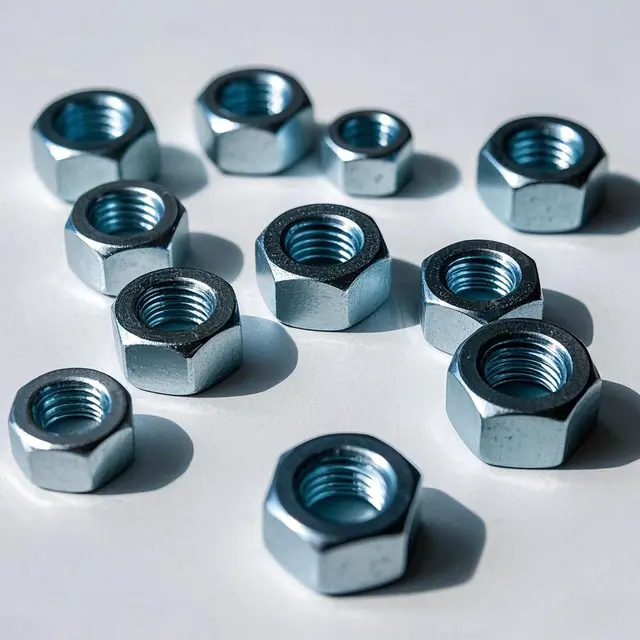
Inconel 617 (UNS N06617 / W.Nr. 2.4663) nuts are high-performance fasteners manufactured from nickel-based solid-solution-strengthened alloys. With excellent high-temperature resistance, oxidation resistance, corrosion resistance, and high strength, they serve as critical connectors in extreme environments. Below is the core information:
| Inconel 617 Nuts (UNS N06617) | ||
| Chemical Composition (%) | Ni ≥ 44.5 | Cr: 20.0-24.0 |
| Mo: 8.0-10 | Fe ≤ 3.0 | |
| Mn ≤ 1.0 | C: 0.05-0.15 | |
| Si ≤ 1.0 | Al: 0.8-1.5 | |
| Ti ≤ 0.6 | Co: 10.0-15.0 | |
| Melting Point (℃) | 1330-1380 | |
| Density (g/cm³) | 8.4 | |
| Application Areas | Inconel 617 is regarded as a premier material for offshore oil and gas extraction equipment, such as offshore pipelines. Using Inconel 617 in high-speed rotating components like aero-engines and gas turbines significantly enhances fatigue resistance and high-temperature performance, ensuring long-term stable operation. | |
Parameters:
- Category: Hexagon Nut
- Product Grade: Class A
- Strength Grade: Grade 8
- Across Flats Width: 8-120
- Height: 5.6-60 (mm)
- Thread Specification: M5-M100
- Surface Treatment: Untreated
1. Material Characteristics
- Chemical Composition (Typical Values):
- Nickel (Ni) ≥ 44.5%, Chromium (Cr) 20-24%, Cobalt (Co) 10-15%, Molybdenum (Mo) 8-10%, Aluminum (Al) 0.8-1.5%, Iron (Fe) ≤ 3.0%, Carbon (C) 0.05-0.15%.
- Strengthening Mechanism: Solid-solution strengthening. The formation of a complex oxide film through high nickel, chromium, cobalt, and molybdenum content enhances high-temperature and corrosion resistance.
- High-Temperature Performance: Operating temperature can reach 1100°C, with short-term tolerance up to 1150°C. It maintains high strength and creep resistance at elevated temperatures.
2. Core Advantages
- High-Temperature Resistance
- Maintains high tensile strength (≥ 769 MPa) and fatigue resistance above 700°C, suitable for long-term high-temperature load-bearing.
- Corrosion Resistance
- Resistant to oxidizing acids (nitric acid, sulfuric acid), chlorides, seawater, and sulfur-containing environments. Particularly resistant to sulfide corrosion, making it suitable for coal-fired power plants and chemical equipment.
- Machinability and Weldability
- Can be formed via hot forging and hot rolling. TIG or MIG welding is recommended using ENiCrMo-3 filler wire, with no post-weld heat treatment required.
3. Application Areas
- Aerospace: Turbine engine combustion chamber bolts, combustion tank fasteners.
- Energy Industry: Gas turbine transition piece bolts, high-temperature heat exchanger bolts for nuclear high-temperature gas-cooled reactors.
- Chemical & Petrochemical: Nitric acid production catalyst support bolts, high-temperature reactor flange bolts.
- Heat Treatment: High-temperature furnace muffle tank and radiant tube connection bolts.
- Nuclear Industry: High-temperature components for nuclear reactors (e.g., helium/helium medium heat exchanger bolts).
4. Standards and Certifications
- International Standards:
- ASTM B166 (Bar), ASTM F467 (Bolts), ISO 4014 (Hexagon Bolts), DIN 931 (DIN Standard Bolts).
- Certifications:
- PED Certification (Pressure Equipment Directive), EN 10204 3.1/3.2 Material Certificates, complies with NACE MR0175 standard for sulfide stress cracking resistance.
5. Manufacturing Process
- Raw Materials: Produced via Vacuum Induction Melting (VIM) + Electroslag Remelting (ESR) to ensure high purity and uniformity.
- Forming Methods:
- Hot Forging: Heated to 1050-1150°C to avoid grain coarsening.
- Cold Working: Solution treatment (1150-1200°C) is required after cold drawing or rolling to restore plasticity.
- Surface Treatment: Options include nickel plating and PTFE coating to enhance corrosion resistance and anti-galling properties.
6. Typical Mechanical Properties (Room Temperature)
| Performance Indicator | Typical Value |
|---|---|
| Tensile Strength | ≥ 769 MPa |
| Yield Strength (0.2%) | ≥ 318 MPa |
| Elongation | ≥ 56% |
| Hardness (HB) | 181 |
7. Global Grade Equivalents
| Country / Region | Standard | Grade |
|---|---|---|
| USA | UNS | N06617 |
| Europe | EN / DIN | NiCr22Co12Mo9 / 2.4663 |
| China | GB/T 15007 | NS3106 |
| Japan | JIS G4902 | NCF617 |
8. Precautions
- Hot Working Control: Avoid dwelling in the sensitive temperature range of 900-1000°C to prevent grain coarsening.
- Environmental Adaptability: Avoid contact with molten metals (e.g., lead, zinc) to prevent hot brittleness.
- Installation Torque: Pre-tightening force must be precisely controlled to avoid stress concentration leading to cracking.
Summary
Inconel 617 nuts, leveraging their high nickel-chromium-cobalt-molybdenum alloy characteristics, excel in extreme high-temperature, high-pressure, and corrosive environments. They are critical materials in aerospace, energy, and chemical industries. Their stringent manufacturing processes and international certifications ensure long-term reliability, making them particularly suitable for cutting-edge applications such as Generation IV nuclear power systems and advanced gas turbines.